This article describes how AccessFlow delivers real-time contractor compliance - from the moment a contractor organisation is registered through to daily site entry, continuous monitoring, and eventual offboarding. Each step in the process is described in the order it occurs, showing how compliance is established, maintained, and enforced as a continuous control system rather than a periodic administrative check.
In most organisations, contractor compliance is spread across disconnected systems. Onboarding happens in one system, training records live in another, and physical access control operates independently of both. The result is structural risk:
AccessFlow eliminates these gaps by unifying contractor management, compliance validation, and physical access enforcement into a single platform. Compliance is not checked periodically - it is evaluated continuously and enforced automatically at the point of entry.
Before any individual contractor can be onboarded, their parent organisation must be registered and verified in AccessFlow. This establishes organisational-level compliance before any workers are introduced into the system.
The contractor organisation submits their company details and compliance documentation through AccessFlow. This includes:
Each submitted document is recorded against the organisation with its issue date, expiry date, and document classification. AccessFlow tracks the validity of every document in real time. If an insurance certificate expires, the organisation's compliance status changes immediately - and this flows down to every worker attached to that organisation.
Approval of the organisation is managed through a configurable workflow. Designated approvers review the submitted documentation and either approve, reject, or request additional information. The approval decision, the approver's identity, and the timestamp are all recorded in the audit trail.
Once the contractor organisation is approved, individual workers can be onboarded. Worker onboarding is a controlled process - not an open registration.
The contractor organisation (or a site administrator) initiates an invitation for each worker. The worker is guided through a structured onboarding workflow:
Each step in the onboarding workflow is validated before the worker can proceed to the next. Configurable approval workflows allow designated site personnel to review and approve submissions at each stage. The worker does not receive site access until every required step is completed and approved.
The onboarding state for every worker is visible in real time - site administrators can see exactly where each worker is in the process, what is outstanding, and what has been approved.
With the worker onboarded and their credentials captured, AccessFlow's compliance rules engine takes over. This is the core mechanism that turns static records into continuous, real-time compliance.
The rules engine continuously evaluates every worker's compliance status against the requirements defined for their role, site, and scope of work. The rules are configurable per site and can include:
The rules engine does not wait for someone to check. It evaluates continuously. The moment a certification expires, an induction lapses, or an organisation's insurance falls out of date, the worker's compliance status changes from compliant to non-compliant. This status change triggers enforcement actions automatically - described in the next step.
Every rule evaluation is logged: what was checked, what the result was, and what action was taken. This provides a complete, auditable record of every compliance decision the system has made.
Compliance is only meaningful if it is enforced at the point of entry. AccessFlow integrates directly with enterprise access control systems to ensure that compliance status governs physical access in real time.
When a worker's compliance status changes, AccessFlow writes the change to the access control system immediately:
A contractor's high-risk work licence expires at midnight. At 12:01 AM, AccessFlow's rules engine detects the expiry and marks the worker as non-compliant for roles requiring that licence. AccessFlow immediately modifies the worker's access group membership in the access control system. When the worker presents their card at the site gate at 6:00 AM, the reader denies entry. No one had to check a spreadsheet, send an email, or make a phone call. The enforcement was automatic and immediate.
For high-risk activities, compliance alone is not sufficient - the worker must also hold a valid permit for the specific work they are performing. AccessFlow embeds permit-to-work directly into the compliance and access control framework.
If a permit expires or is revoked, AccessFlow enforces the change immediately through the access control system - the same mechanism used for compliance enforcement.
Contractor compliance is not a one-time check at onboarding. AccessFlow monitors every worker's compliance status continuously throughout their engagement.
AccessFlow provides advance notification of upcoming compliance expirations to both the worker and their contractor organisation, giving them the opportunity to renew before access is affected. If the expiry passes without renewal, enforcement is automatic.
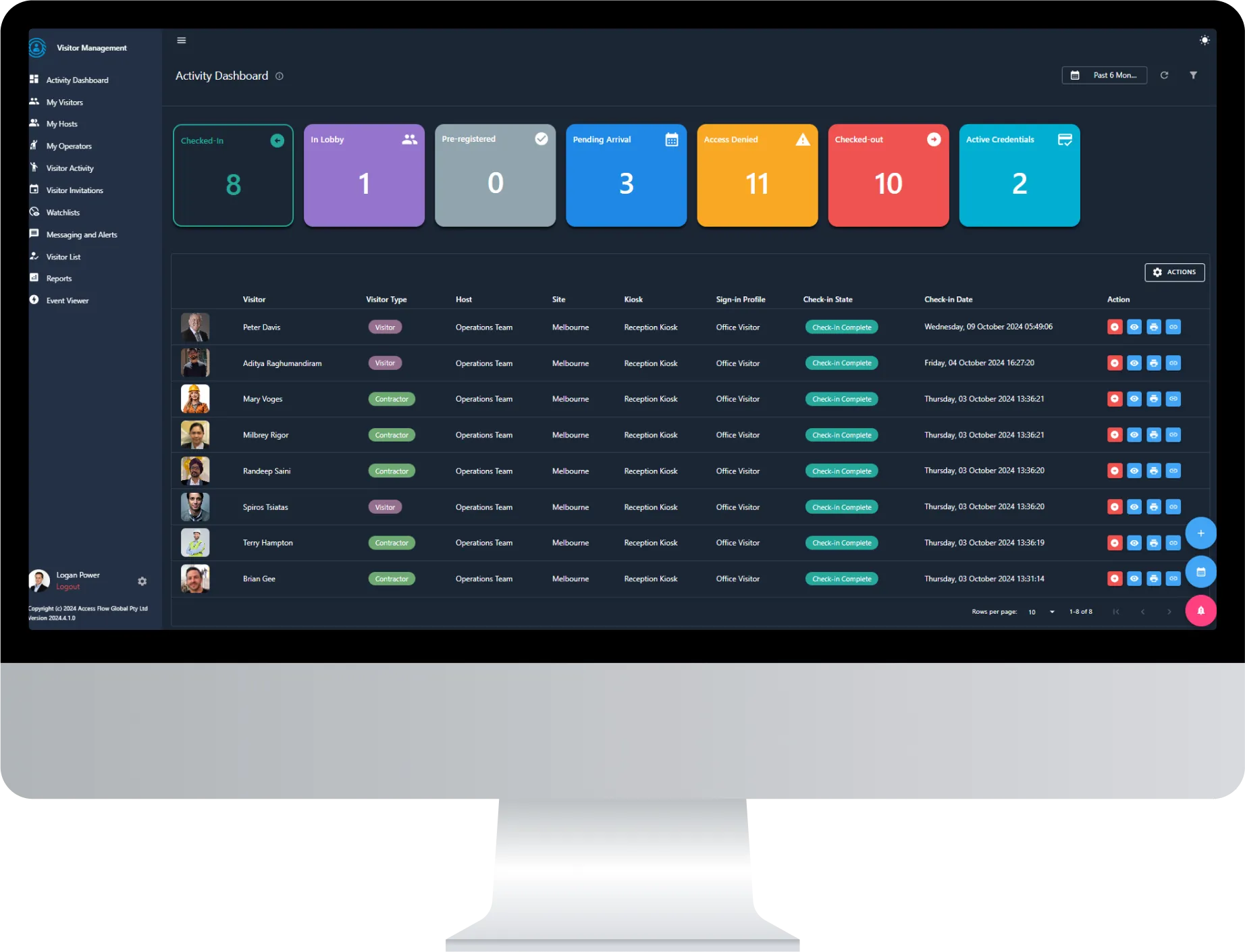
Site administrators have real-time visibility into the compliance status of every worker and every contractor organisation. Dashboards show current compliance rates, upcoming expirations, and any workers who have been restricted due to non-compliance.
Every action described in the steps above is recorded in an immutable audit trail. This provides the evidentiary basis for compliance governance.
AccessFlow enforces governance boundaries through platform-level data partitioning. Operators are restricted to only the sites, contractors, and compliance data relevant to their scope of responsibility. This is enforced at the platform architecture level, not merely as an interface configuration.
This is reinforced through role-based access control, creating a dual-layer governance model: role-based permissions define what an operator can do, and data partitioning defines what data they can see. All reporting - standard or custom - automatically respects these partitioning rules. Site operators only see data relevant to their site, while regional administrators can generate consolidated reports across multiple sites without bypassing governance controls.
When a contractor's engagement ends, AccessFlow manages the offboarding process to ensure clean and complete access revocation.
The eight steps above form a continuous cycle. The following table summarises how each step contributes to real-time contractor compliance: