Visitor Management for Banks and Financial Institutions
How AccessFlow Transforms Security, Compliance, and Operational Control
The Tuesday Morning Problem
It's 9:45 AM on Tuesday. Your regional bank headquarters hosts 40 scheduled visitors today: external auditors conducting a quarterly review, HVAC contractors servicing the data center, a fintech vendor demonstrating new payment software, job candidates interviewing for compliance roles, and a regulatory inspection team arriving unannounced.
Your front desk staff is overwhelmed. The paper sign-in book is illegible. The auditors need access to the 3rd floor executive suite. The HVAC contractors need data center access but haven't completed the mandatory cybersecurity briefing. The job candidates are waiting in the lobby with no clear instructions. And the regulatory inspector just walked in demanding to see visitor logs from the past six months---immediately.
Sound familiar?
Why Visitor Management Is Critical in Banking
In banking and financial services, visitor management isn't about hospitality---it's a security, identity verification, and regulatory compliance control embedded directly into your institution's risk framework. Banks face unique challenges:
- Regulatory scrutiny: Surprise audits, compliance reviews, and examiner visits require instant access to visitor records
- Physical security threats: Unauthorized access to vaults, data centers, trading floors, or customer data areas
- Data protection: Visitors near workstations with customer PII, financial data, or confidential transaction information
- Insider threat prevention: Contractors, vendors, and temporary workers with prolonged facility access
- Emergency accountability: Knowing exactly who's in the building during evacuations, active threats, or disasters
- Multi-site complexity: Headquarters, branches, operations centers, and data centers all requiring consistent controls
AccessFlow Visitor Management provides a comprehensive, integrated solution specifically designed to address these banking-specific challenges.
Real-World Scenarios
Real-World Scenario 1: The Unannounced Regulatory Examination
The Challenge:
A federal banking regulator arrives unannounced at your headquarters at 10:00 AM for a routine examination. The examiner demands:
- Immediate access to the executive floor
- Complete visitor logs for the past 12 months
- Evidence that all visitors signed confidentiality agreements
- Proof that contractor access to sensitive areas was properly authorized
Your paper logbook is missing pages. Your receptionist has no idea which contractors accessed the data center last quarter. You're scrambling.
The AccessFlow Solution:
- Pre-registration system recognizes examiner category: Receptionist selects 'Regulatory Examiner' visitor type, triggering automatic workflows
- Instant ID verification: Receptionist scans examiner's government-issued credentials using tablet camera; AccessFlow validates ID expiry and records details
- Digital confidentiality agreement: Examiner reviews and signs NDA on tablet; timestamped signature captured
- Automatic access credential: AccessFlow sends command to Genetec Security Center, creating temporary cardholder with executive floor access valid for examination duration
- Instant compliance reports: Compliance officer exports 12-month visitor audit report (5 minutes instead of 5 days), filtered by visitor type, location, and access area, with signed agreements attached
- Genetec video correlation: AccessFlow check-in triggers Genetec Omnicast video bookmark, creating visual record of examiner arrival
Result: Examiner checked in and escorted to executive floor within 10 minutes. Compliance officer delivered complete audit trail within 30 minutes. Regulator commended your visitor management controls. Potential citation avoided.
Real-World Scenario 2: Data Center Maintenance Access Control
The Challenge:
Your bank's data center hosts core banking systems, customer databases, and payment processing infrastructure. A cooling system failure requires urgent HVAC contractor access. However:
- Data center requires background check clearance
- Contractors must complete cybersecurity awareness training
- Access requires approval from both Facilities Manager and Chief Information Security Officer
- Physical access must be time-limited to work window
- Video surveillance must record entire visit
Coordinating these requirements manually takes hours---but your systems are overheating now.
The AccessFlow Solution:
- Pre-registration portal: HVAC contractor receives email link 24 hours before visit, uploads insurance certificate, background check, and contractor license via web portal
- Automated document validation: AccessFlow verifies insurance expiry, checks background clearance date, validates contractor license number
- Digital e-learning: Contractor completes 15-minute cybersecurity awareness module with competency test; digital certificate issued upon pass
- Approval workflow: AccessFlow automatically routes request to Facilities Manager → CISO; both approve via mobile app with one-tap authorization
- Gallagher access control integration: Upon final approval, AccessFlow creates temporary cardholder in Gallagher Command Centre with data center access group, valid 8:00 AM - 5:00 PM for work day only
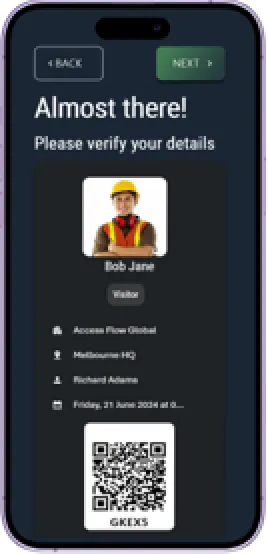
- Physical credential: Contractor receives QR code via SMS; presents at reception; receptionist prints visitor badge with photo, QR code, and 'DATA CENTER ACCESS' indicator
- Access enforcement: Contractor badges QR code at data center door → Gallagher grants access, logs event. At 5:00 PM, Gallagher automatically deactivates credential
- Video surveillance: AccessFlow triggers Genetec Omnicast video bookmark when contractor badges into data center; video preserved for audit trail
- Automatic check-out: When contractor badges out and leaves building, AccessFlow permanently revokes access and archives visit record
Result: Zero-touch access control. No manual credential programming. No forgotten deactivations. Complete compliance documentation automatically generated. Critical system repaired on schedule with full security controls enforced.
Real-World Scenario 3: Emergency Evacuation and Mustering
The Challenge:
Fire alarm activates at 2:30 PM in your 12-story headquarters building. You have:
- 450 employees
- 35 visitors currently checked in
- 12 contractors working on various floors
- Unknown number of delivery drivers, job candidates, and walk-ins
Your paper sign-in book shows 28 visitors checked in today---but 7 already left without signing out. Emergency wardens are conducting manual roll calls with clipboards. It's taking 25 minutes to determine if anyone's missing. First responders are waiting for clearance to enter the building.
The AccessFlow Solution:
- Unified personnel database: AccessFlow maintains single real-time database of all on-site personnel: employees badged in via Genetec, visitors checked in via AccessFlow kiosks, contractors pre-registered
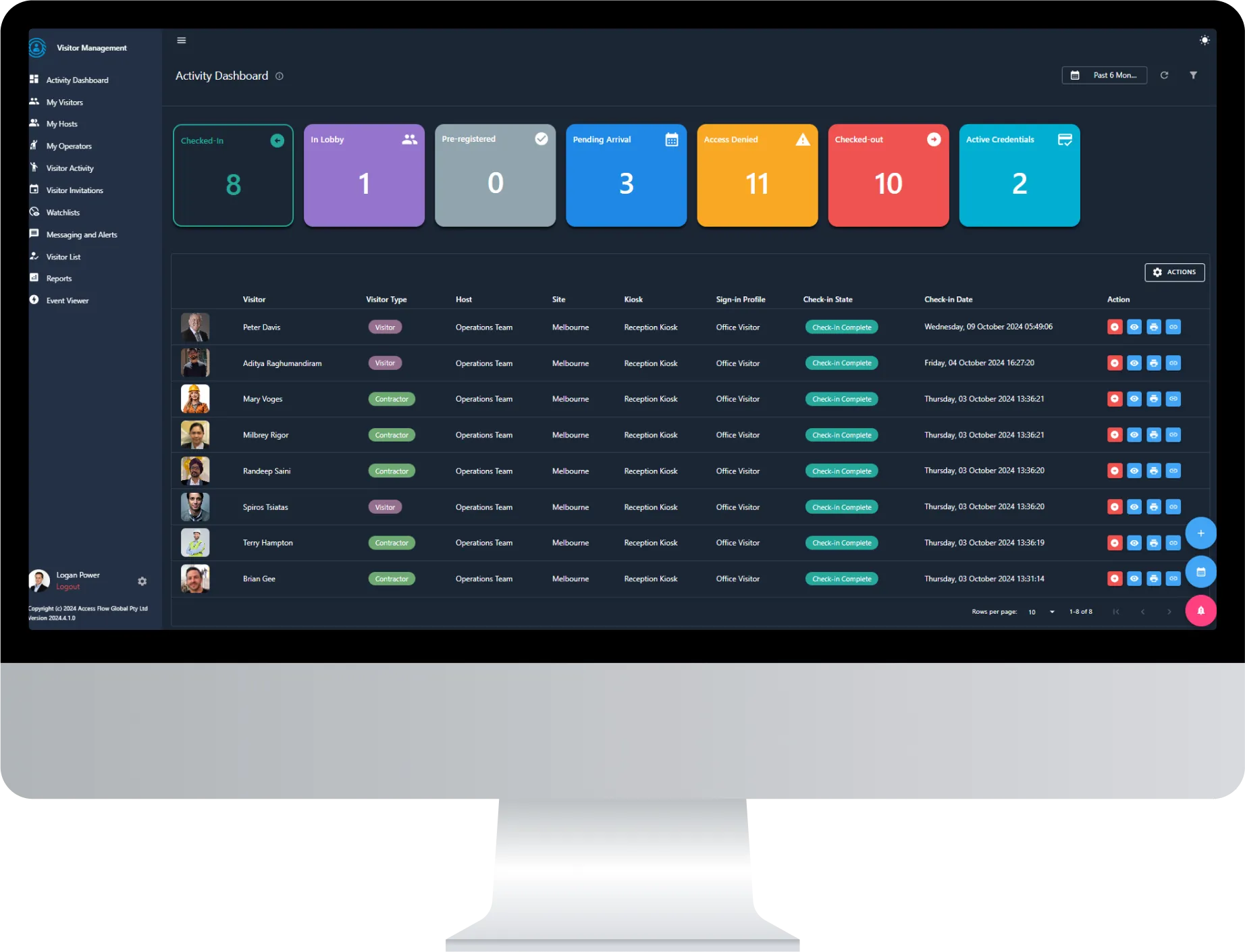
- Emergency mode activation: Security officer activates emergency mustering in AccessFlow dashboard with one button
- SMS/email alerts: Automatic SMS and email sent to all on-site personnel: 'Emergency evacuation. Proceed to Assembly Point A. Acknowledge receipt.'---click-to-confirm link included
- Mobile mustering: Emergency wardens use AccessFlow mobile app at assembly points; scan visitor badges or employee cards with smartphone camera; system instantly marks personnel as 'accounted for'
- Real-time dashboard: Emergency command center views live dashboard: 497 total on-site → 489 accounted for → 8 missing
- Missing persons report: System displays 8 missing individuals with photos, last known Genetec access location, mobile numbers, emergency contacts
- Genetec video integration: For each missing person, AccessFlow provides link to Genetec Omnicast showing last door access event and camera footage
- First responder support: Emergency coordinator exports PDF report with missing persons' names, photos, last locations---handed to fire department
- All-clear protocol: Once building cleared and all personnel confirmed safe, AccessFlow documents complete evacuation timeline for post-incident review
Result: Complete personnel accountability achieved in 8 minutes (vs. 25+ minutes with manual roll call). First responders provided accurate missing persons list within 10 minutes. All 8 'missing' individuals located: 5 had already left building via different exit; 2 were in restrooms when alarm sounded; 1 was hearing-impaired and didn't hear alarm---located via last door access. Zero casualties. Complete audit trail generated for insurance and regulatory review.
AccessFlow Core Capabilities for Banking
1. Risk-Based Visitor Classification
Not all visitors are equal. AccessFlow enables banks to define visitor categories with differentiated security controls:
General Visitors (interviews, meetings)
- Access Zones: Lobby, meeting rooms only
- Requirements: Basic ID check, host approval
- Approval Level: Manager
Regulators / Auditors
- Access Zones: Executive floors, audit rooms
- Requirements: Government ID verification, NDA signature
- Approval Level: Compliance Officer
IT / Technology Vendors
- Access Zones: Server rooms, IT closets
- Requirements: Background check, cyber training, insurance
- Approval Level: CISO + Facilities
Data Center Contractors
- Access Zones: Data center, cooling systems
- Requirements: Background check, clearance, e-learning, 2-step approval
- Approval Level: CISO + VP Operations
Armored Car / Cash Services
- Access Zones: Vault, cash handling areas
- Requirements: Armed guard credentials, background clearance, escort required
- Approval Level: Security Director
2. Pre-Registration and Host Accountability
Walk-in visitors are security risks. AccessFlow enforces pre-registration:
- Web-based pre-registration portal: Visitors receive email link from host, complete profile online 24-48 hours before arrival
- Host accountability: Every visitor linked to named employee responsible for their conduct and supervision
- Purpose documentation: Required fields: visit purpose, duration, meeting location, areas requiring access
- QR code delivery: Approved visitors receive QR code via email/SMS for rapid check-in (no front desk bottleneck)
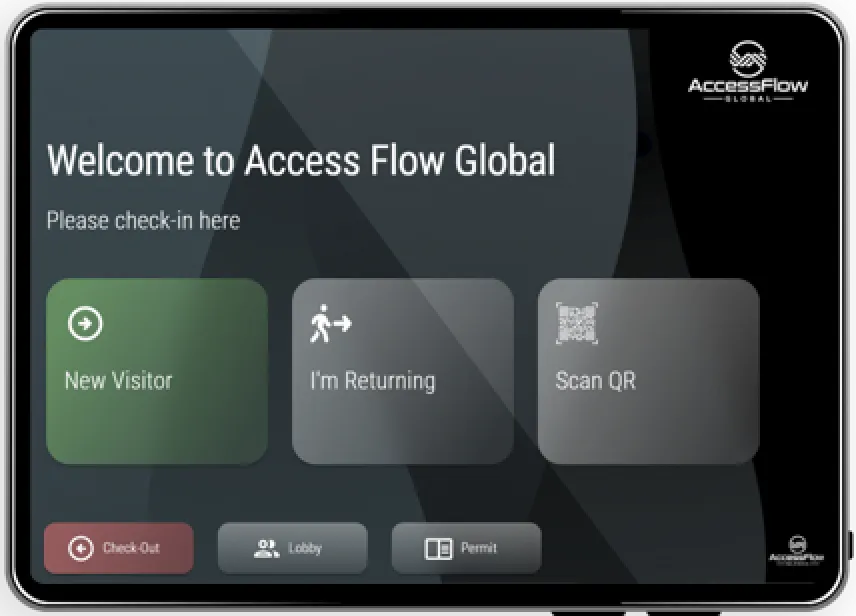
- Check-in flexibility: Physical kiosks (tablets), contactless web kiosks (visitor's phone), or receptionist-assisted
- Lobby mode: High-security branches require visitors to wait for explicit host approval before receiving access badge
3. Identity Verification and Validation
Know exactly who's in your building:
- Photo ID capture: Kiosk camera or mobile upload captures government-issued ID (driver's license, passport)
- OCR scanning: Automated extraction of name, ID number, expiry date, date of birth
- Expiry validation: System automatically flags expired IDs and blocks check-in
- Profile matching: ID name must match pre-registered visitor name
- Watchlist screening: Automatic alerts if visitor matches deny list or person of interest
- Configurable enforcement: Mandatory for data centers/vaults; optional for low-security meeting rooms
4. Digital Inductions and Compliance
Replace paper sign-in books with auditable digital records:
- Site safety briefings: Emergency procedures, evacuation routes, prohibited items
- Confidentiality agreements: Digital NDA signature with timestamp and IP address
- Data privacy acknowledgments: 'I understand I may see confidential customer information and agree not to disclose'
- Cybersecurity awareness: E-learning modules for contractors with data center or IT access
- Photo/video consent: Required acknowledgment that premises have surveillance cameras
- Centralized storage: All signed documents stored indefinitely in AccessFlow database, instantly retrievable
5. Time-Bound Access Control
Visitors shouldn't have indefinite access:
- Visit duration limits: Access expires automatically at scheduled departure time
- Zone restrictions: Visitors can only access pre-approved areas (lobby, 5th floor meeting room, etc.)
- Automatic credential expiry: Physical/digital credentials deactivate when visit ends or visitor checks out
- Overstay alerts: System notifies security if visitor remains on-site past scheduled departure
- Check-out enforcement: Email reminder sent to host if visitor hasn't checked out within 30 minutes of scheduled end
6. Real-Time Visibility and Dashboards
Know who's in your building---right now:
- Live check-in/check-out status: Dashboard shows all currently on-site visitors with photos, hosts, locations
- Multi-site visibility: Regional security teams monitor all branches from central dashboard
- Filtered views: View by visitor type, location, floor, host, duration
- Expected arrivals: See upcoming visitors scheduled for today/this week
- Overdue check-outs: Flag visitors who should have left but haven't
- Mobile access: Security officers monitor from smartphones/tablets
AccessFlow Integrations: Unified Security Ecosystem
AccessFlow doesn't replace your existing security infrastructure---it enhances it by providing intelligent orchestration and compliance automation.
Physical Access Control Integration
AccessFlow integrates with leading access control platforms to automate credential management and enforce visitor access policies at physical doors, turnstiles, and secure zones.
Gallagher Command Centre Integration
- Bidirectional sync: AccessFlow ↔ Gallagher REST API with real-time communication
- Automatic cardholder creation: When visitor checks in, AccessFlow creates temporary Gallagher cardholder with photo
- Dynamic access groups: Visitor approved for '3rd Floor Conference Room' → automatically added to Gallagher access group
- Credential types: Physical cards, HID mobile credentials (Bluetooth), QR codes
- Time-bound access: Gallagher credentials expire automatically when visit ends
- Access event feedback: Gallagher door access events flow back to AccessFlow for audit trail
Genetec Security Center (Synergis) Integration
- Cardholder sync: AccessFlow creates Genetec cardholders upon visitor check-in
- Access group assignment: Visitors automatically assigned to appropriate Genetec access groups based on approvals
- Credential management: Physical cards, HID Mobile Access, custom card formats
- Video integration (Omnicast): AccessFlow triggers Genetec video bookmarks at check-in, critical events, check-out
- Alarm integration: Failed access attempts, overstays, or watchlist matches trigger Genetec alarms
- Unified audit trail: AccessFlow compliance reports include Genetec access events and video links
Inner Range Integriti Integration
- Cardholder provisioning: AccessFlow creates temporary cardholders in Integriti upon visitor approval
- Access level assignment: Visitors assigned to appropriate Integriti access levels and time zones
- Credential formats: Support for Wiegand, HID, custom formats
- Event monitoring: Real-time access granted/denied events from Integriti to AccessFlow
Video Management Integration
- Genetec Omnicast: Automatic video bookmarks at check-in, sensitive area access, failed access attempts, check-out; deep links from AccessFlow to video footage; preserved video evidence for investigations
- Video correlation: Visitor audit reports include direct links to camera footage showing physical presence and movements
Badge Printing Integration
- Automatic badge generation: Upon check-in, AccessFlow sends print job to Zebra, Fargo, or Evolis badge printer
- Badge elements: Visitor photo, name, host, company, date, QR code, access zones, expiry time
- Color-coded badges: Different badge colors/designs per visitor category (visitor vs. contractor vs. VIP)
- Magnetic stripe encoding: For facilities using mag stripe readers, AccessFlow encodes visitor ID onto badge
Emergency Management Integration
- Unified personnel database: Combines employees (from access control), visitors (from AccessFlow), contractors (from Workforce Management)
- SMS/email alerts: Automatic emergency notifications to all on-site personnel with acknowledgment tracking
- Mobile mustering: Emergency wardens use smartphones to scan badges/QR codes at assembly points
- Real-time accountability: Live dashboard showing accounted vs. missing with last known locations from access control
- First responder reports: Generate PDF with missing persons' photos and last access locations for fire/police
Key Benefits for Banks
Security and Risk Reduction
- Zero unauthorized access: Physical access control integration enforces visitor approvals at doors
- Identity assurance: Know exactly who's in your building with photo ID verification
- Insider threat prevention: Watchlist screening, access restrictions, video surveillance integration
- Data protection: Confidentiality agreements enforced before facility access granted
- Time-limited access: Automatic credential expiry prevents lingering or unauthorized return visits
Regulatory Compliance
- Instant audit reports: Export complete visitor history in seconds (vs. days of manual research)
- Complete audit trail: Who visited, when, why, who approved, what they signed, where they accessed
- Signed NDAs: Digital signatures with timestamps and IP addresses, instantly retrievable
- Video evidence: Genetec integration provides visual proof of physical presence
- Regulatory examiner-ready: Demonstrate robust visitor management controls during unannounced inspections
Operational Efficiency
- 80%+ reduction in admin time: Eliminate manual logbooks, spreadsheets, credential programming
- Front desk efficiency: Pre-registered visitors with QR codes check in within 30 seconds
- Zero manual credential management: Access control systems updated automatically---no security staff intervention
- Multi-site management: Centralized visibility and control across headquarters and branches
- Scalability: Handle 10 visitors/day or 500 visitors/day with same system
Emergency Preparedness
- 80% faster mustering: Real-time accountability vs. 25+ minute manual roll calls
- Missing persons identification: Instant list with photos and last known locations
- First responder support: Accurate data for fire/police/EMS
- Complete incident documentation: Timeline, notifications, accountability records for post-incident review
Deployment Options
- Cloud (SaaS): Fully managed hosting, automatic updates, accessible from anywhere
- On-premises: Complete data sovereignty, hosted on bank's infrastructure
- Hybrid: On-premises core with cloud-based pre-registration portal
- High availability: Redundant servers, failover capability, 99.9% uptime SLA
Conclusion
In banking and financial services, visitor management is a critical security control---not an administrative nicety. AccessFlow transforms visitor management from a paper logbook liability into a comprehensive, integrated, auditable security system that protects your people, data, facilities, and reputation.
By integrating with Gallagher Command Centre, Genetec Security Center, Inner Range Integriti, and video management systems, AccessFlow provides unified orchestration that ensures only authorized visitors access your facilities---and that you can prove it when regulators, auditors, or investigators ask.
Whether you're managing a single headquarters or a network of branches and operations centers, AccessFlow scales to meet your needs while maintaining consistent security controls and regulatory compliance across all locations.
Contact Information
AccessFlow Global Pty Ltd
6/20-22 Hardner Road, Mount Waverley
Victoria 3149, Australia
Phone: (+61) 1300 007 213
Email: info@accessflowglobal.com
Website: accessflowglobal.com